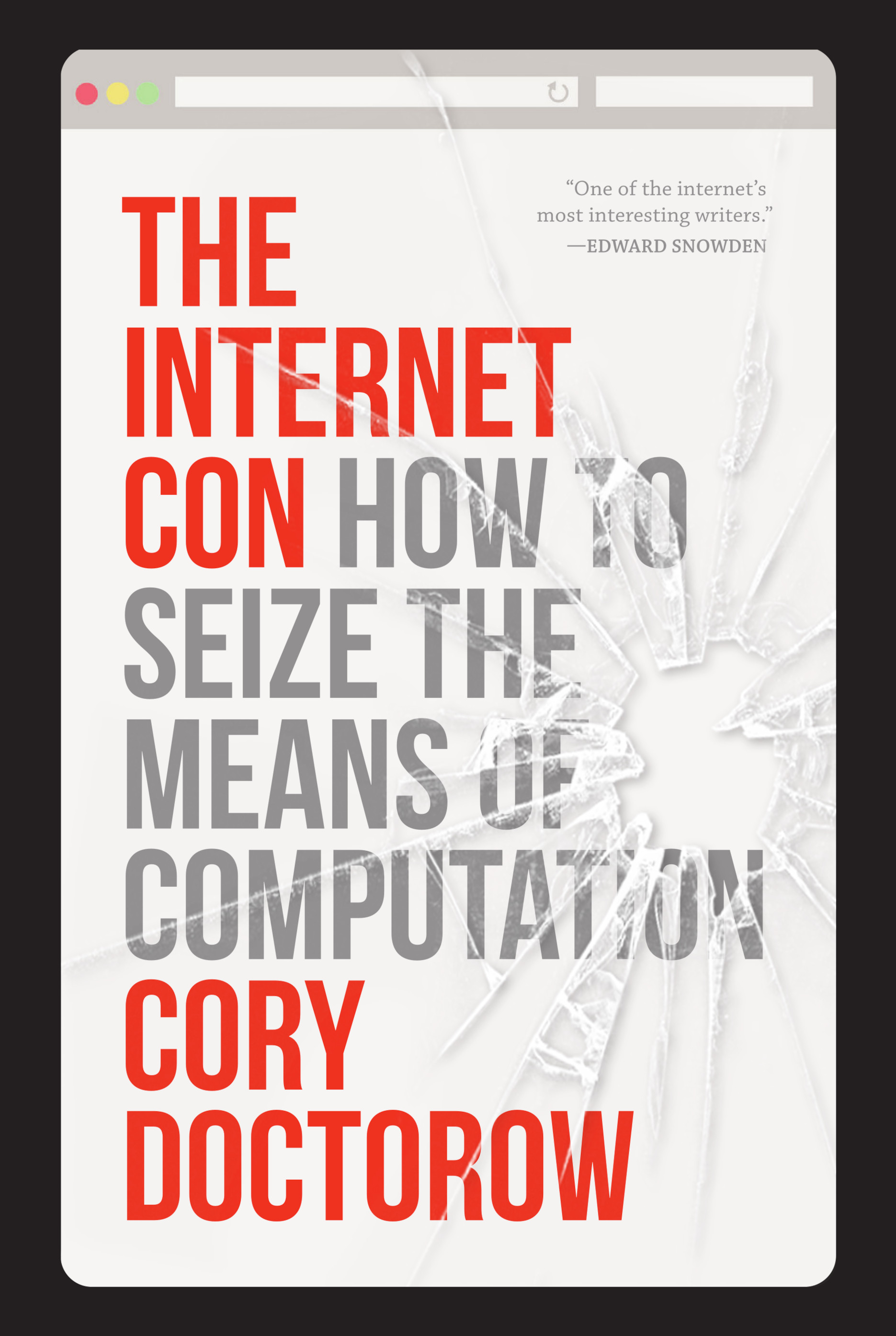

The Internet Con

How to Seize the Means of Computation

When the tech platforms promised a future of "connection," they were lying. They said their "walled gardens" would keep us safe, but those were prison walls.

The platforms locked us into their systems and made us easy pickings, ripe for extraction. Twitter, Facebook and other Big Tech platforms hard to leave by design. They hold hostage the people we love, the communities that matter to us, the audiences and customers we rely on. The impossibility of staying connected to these people after you delete your account has nothing …

5.28 X 7.95 X 1.18 inches | 0.74 pounds, 192 pages

English language

Published Sept. 4, 2023 by Verso.

Show more
ISBN:
978-1-80429-124-5
Copied ISBN!

View on OpenLibrary

Subjects
  • internet
  • antitrust
  • social media
  • World Wide Web
  • Technology Studies
  • Public Policy - Science & Technology Policy
  • Privacy & Surveillance
  • Political Science - Privacy & Surveillance

Reviews

reviewed Le rapt d'Internet by Cory Doctorow (Société numérique, #13)

Mouais...

Vu les sous-titres, "manuel", "comment", on s'attend à quelque chose d'un peu faisable. Au lieu de ça, l'auteur utilise le livre pour expliquer toutes ses thèses... Intéressantes et justes, mais s'il n'y avait pas eu le sous-titre, ç'aurait été beaucoup plus "dans le ton".

Au lieu de ça, la seule véritable chose que l'auteur indique qu'il faut faire, c'est que les autorités américaines se sortent les doigts du cul et fassent revivre de véritables lois / procès antitrusts. En tant que citoyen français (et donc non américain), ça m'en touche une sans faire bouger l'autre.

Donc 2* pour qui veut savoir ce que pense Doctorow, et ça s'arrête là. Ne cherchez pas: il n'y a rien que vous pouvez faire et qui soit décrit dans cet ouvrage (ah si, évidemment, ne pas utiliser les services des GAFAM -- voilà, j'ai résumé le livre, vous n'êtes pas obligés de l'acheter).


Review of 'The Internet Con' on 'Storygraph'

I consider myself pretty well versed in the shortcomings of capitalism, but this book still managed to shock me time and time again with tales of the brazen greed of tech companies over time. It was an easy read, which I appreciated, and I greatly enjoyed the conversational and sometimes colorful tone of writing.

Yet even though the author said multiple times that he would explain how we go about fixing the problems of Big Tech, he never really did. That is, unless I somehow figure out how to suddenly make Congress listen to me instead of a huge corporation, or learn how to reverse-engineer my own social media company. Nevertheless, it’s a great read, and one that more people probably should.