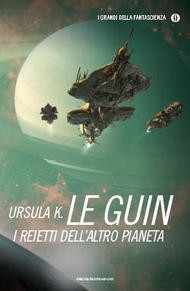
I reietti dell'altro pianeta

"C'era un muro... Come ogni altro muro, anch'esso era ambiguo, bifronte. Quel che stava al suo interno e quel che stava al suo esterno dipendevano dal lato da cui lo si osservava." Sui dei fronti del muro, due pianeti gemelli, Urras e Anarres, illuminati da uno stesso sole ma divisi da una barriera ideologica antica di secoli. Urras è fittamente popolato, tecnologicamente avanzato, ricco, florido, retto da un'economia liberista. Da qui sono partiti nella notte dei tempi i seguaci di Odo che hanno colonizzato l'arido Anarres, fondandovi una comunità anarchico-collettivista …

Paperback, 340 pages

Italian language

Published Aug. 16, 2014 by Mondadori.

Show more
ISBN:
978-88-04-64249-7
Copied ISBN!

View on OpenLibrary

Reviews

This novel is not about a utopia

At first I thought this novel was going to have a setting of utopia versus dystopia. However, the book goes much deeper than that. There isn't actually any kind of utopia presented really, because the book critically engages with the "utopian" anarchist society and interestingly highlights possible conflicts and issues within such a society as well. Philosophical themes are also explored in dialogue between characters, discussing moral dilemmas and societal issues, arguably making the dialogue the best part of the book with the world building being a close second.

Throughout the whole book you can also see conflict of opposing concepts, such as capitalism and socialism, rich and poor, past and present, individuality and society, hierarchy and anarchy, and the possessed and the dispossessed. Even the protagonists scientific theories attempt to unite two opposing concepts of time.

Altogether, an incredible book I cannot recommend enough, and unexpectedly funny at times too!

Le Guin is simply in a league of her own

I think about a meme I once saw all the time. It said “explaining patriarchy to a man is like explaining to someone who has never heard of a skeleton that there are bones inside your body.” Well, that sentiment applies to a great many things, including explaining that capitalism is a failed experiment to most anyone on our earth today.

Yes, this novel is set between two worlds, one a capitalist society, and one an anarcho-communist. But to reduce this story to that is doing it a great disservice.

170 years after a group of anarchist revolutionaries leave their planet to settle on the moon, a man from this isolated society is invited as a guest back to the home planet.

Le Guin masterfully conveys that poignant, profound feeling of excitement, homesickness, exhaustion, and self-discovery that comes with traveling. Evokes the universal experience of going to …

Denkanstoßend

Den Roman habe ich vor allem deshalb mit in den Urlaub genommen, weil er das "Leitbuch" dieser Bookwyrm-Instanz ist und ich herausfinden wollte, was denn dahinter steckt. Vielen Dank an die Admins für den Hinweis auf das Buch, sonst hätte ich es sicher nicht gefunden!

Als 3. Generation Ost habe ich das Buch zunächst als Reflexion des kalten Kriegs und als Vergleich zwischen Ostblock und westlichem Abendland gelesen. Vor allem haben mich die Probleme auf Anarres angeregt -- wie kommt es zu Machtstrukturen, obwohl Macht gerade nicht gewollt ist, wie kann eine solche Gesellschaft (Hungers)krisen überstehen, wie kann eine solche Gesellschaft mit anderen, aggressiveren Gesellschaft in Kontakt sein?

Neu für mich war in dem Buch der wiederholt auftauchende Begriff des Anarchosyndikalismus. Ich erinnerte mich vage an einen Essay von Noam Chomsky ("What is the Common Good?"), wo dieser über diesen Begriff sprach und dabei Rudolf Rocker zitierte, in …

A complex book of ambiguous utopias

A complex book of big ideas. We follow a scientist that ends up embroiled in the sociological implications of his home, the anarchist utopia of the moon Anarres, and how it differs from the planet Urras, which heavily features a more capitalist society. It's an interesting political treatise on these various types of societies and how they both fail at achieving a real utopia, for different reasons. This is a book that really makes you think and wonder at what we could be as a society.

For a longer review, check out my blog: strakul.blogspot.com/2025/05/book-review-dispossessed-by-ursula-k-le.html

Enjoyable and thought provoking

I'm have only read this once before and remember thinking it was heavy which - while not putting me off re-reading - meant it never floated to prominence on my to-read list. This time I found it, not "lighter" per se, but something, certainly. Overall, it meant that I really enjoyed it in ways I wasn't expecting.

Structurally, I liked the interweaving twin timelines (in a book about the physics of simultaneity and the past, present and future being present together was a nice touch). And this theme was interesting to see having just read The River Has Roots and its riddles relying on the acceptance of a past, present and future.

But so much to think on freedom.

reviewed The Dispossessed by Ursula K. Le Guin

Surprise Anarchy

Went into this book having heard not a lot about it, and did not expect it to turn into an anarchist manifesto, but was pleasantly surprised by the depth of the discussions between the characters and the vivacity of the world described. Will definitely purchase a copy for myself.

Uno dei libri più belli che abbia mai letto

Un libro di fantascienza geniale, avvincente e al tempo stesso ricco di significato. Negli ultimi anni ho tratto grande piacere dallo studio del pensiero anarchico e delle sue differenze con il comunismo autoritario (e chiaramente con il capitalismo). Penso che il pensiero anarchico sia criminalmente escluso dagli studi scolastici e che moltissime persone, per questo motivo, non sappiano realmente cosa sia. I reietti dell'altro pianeta immagina un'utopia anarchica, dandole però sostanza: è bellissimo vedere come funzionerebbe una società anarchica secondo Ursula Le Guin, anche perché ne presenta anche le possibili criticità. La critica feroce alla concezione del lavoro e dello sfruttamento nel capitalismo sono da pelle d'oca. Ho imparato più sull'anarchia leggendo lei che leggendo Kropotkin!