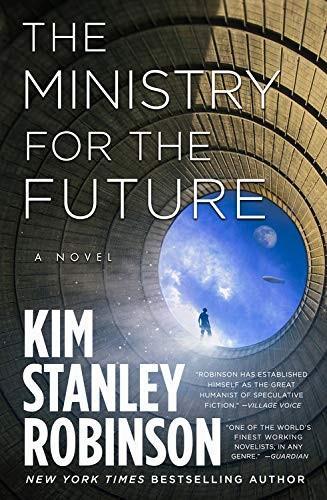
Established in 2025, the purpose of the new organization was simple: To advocate for the world's future generations and to protect all living creatures, present and future. It soon became known as the Ministry for the Future, and this is its story.
From legendary science fiction author Kim Stanley Robinson comes a vision of climate change unlike any ever imagined.
Told entirely through fictional eye-witness accounts, The Ministry For The Future is a masterpiece of the imagination, the story of how climate change will affect us all over …
Established in 2025, the purpose of the new organization was simple: To advocate for the world's future generations and to protect all living creatures, present and future. It soon became known as the Ministry for the Future, and this is its story.
From legendary science fiction author Kim Stanley Robinson comes a vision of climate change unlike any ever imagined.
Told entirely through fictional eye-witness accounts, The Ministry For The Future is a masterpiece of the imagination, the story of how climate change will affect us all over the decades to come.
Its setting is not a desolate, post-apocalyptic world, but a future that is almost upon us - and in which we might just overcome the extraordinary challenges we face.
It is a novel both immediate and impactful, desperate and hopeful in equal measure, and it is one of the most powerful and original books on climate change ever written.
Lese ich sicher nicht weiter, Blockchain-Bullshit.
1 star
Wie kann man nur auf die unendlich dämliche Idee kommen komplett unironisch die scheiss Blockchain als Lösung für die Klimakrise anzubieten?
Nein, das geht gar nicht. Auch nicht in einem fiktiven Werk.
By which I mean it's long and has an interesting idea for a plot, but is written in a way that isn't always interesting.
There's something didactic about KSR's novels. He does a lot of telling rather than showing. There are pages and pages of this. Some of it was so tedious that in the last 20% of the book I skipped over parts. I longed for it all to be over so that I could move on to something more interesting and better written.
There are chapters narrated from the point of view of unidentified people who are scientists, refugees, etc. A lot of these all sound like the same rather breathless, over-excited person.
Because of these faults I wouldn't particularly recommend this book.
Hier geht um die großen Themen unserer Zeit geht: Klimawandel, Korruption, politisches Versagen, Demokratieuntergang, Hang zur Gewalt als Ausdrucks- und Gestaltungsmittel. Alles drin, alles dran.
Aber wie. Einen nachvollziehbaren Erzählstrang gibt es nicht. Einen Plot? Gibt es nicht. Statt dessen gibt es viel meinungsschwangeren Info-Dump. Dieser wird so unstrukturiert dargeboten wie ein Manuskriptentwurf. Es fühlt sich beim Umblättern an wie eine Sammlung von Schulaufsätzen.
Dieses Buch wollte mal eine gut erzählte Geschichte in Romanform werden, hat aber leider die entscheidenden Überarbeitungsschritte nicht bekommen.
Das ist kurz vor unlesbar. Leider. Es ist sehr schade um die Themen.
KSR trying to answer "how to write about/actually respond to climate change"
4 stars
So his answers for both, basically: maximalism. The point he's sort of making is that making the planet safely inhabitable is going to take every tactic and every ideology not necessarily working together but working on some piece of the thing. No one actor gets to be the hero (though I do enjoy that KSR's favorite kind of protagonist remains the middle-aged competent lady technocrat–guy's got a type) and while he's sort of indicating that capitalism as we know it has to die, he's not saying that happens through inevitable worker uprising. Some of it's coercion of central banks and some of it's straight-up guerrilla terrorism. Geoengineering happens at varying scales for better and for worse. Massive economic collapses occur. Millions die. And the point I think from KSR is that's the outcome in his most optimistic take. In general with KSR I don't know if I ever fully agree, …
So his answers for both, basically: maximalism. The point he's sort of making is that making the planet safely inhabitable is going to take every tactic and every ideology not necessarily working together but working on some piece of the thing. No one actor gets to be the hero (though I do enjoy that KSR's favorite kind of protagonist remains the middle-aged competent lady technocrat–guy's got a type) and while he's sort of indicating that capitalism as we know it has to die, he's not saying that happens through inevitable worker uprising. Some of it's coercion of central banks and some of it's straight-up guerrilla terrorism. Geoengineering happens at varying scales for better and for worse. Massive economic collapses occur. Millions die. And the point I think from KSR is that's the outcome in his most optimistic take. In general with KSR I don't know if I ever fully agree, but I always feel fully engaged.
This is also probably the most not-novel-y of his novels in that there's a couple of recurring characters running through the book but a ton of it's just first-person unnamed narration of events happening around the world. Someone describing a drought, a refugee describing a camp, a miner describing the nationalization of his mine. One very weird and fun chapter from the point of view of actual carbon.