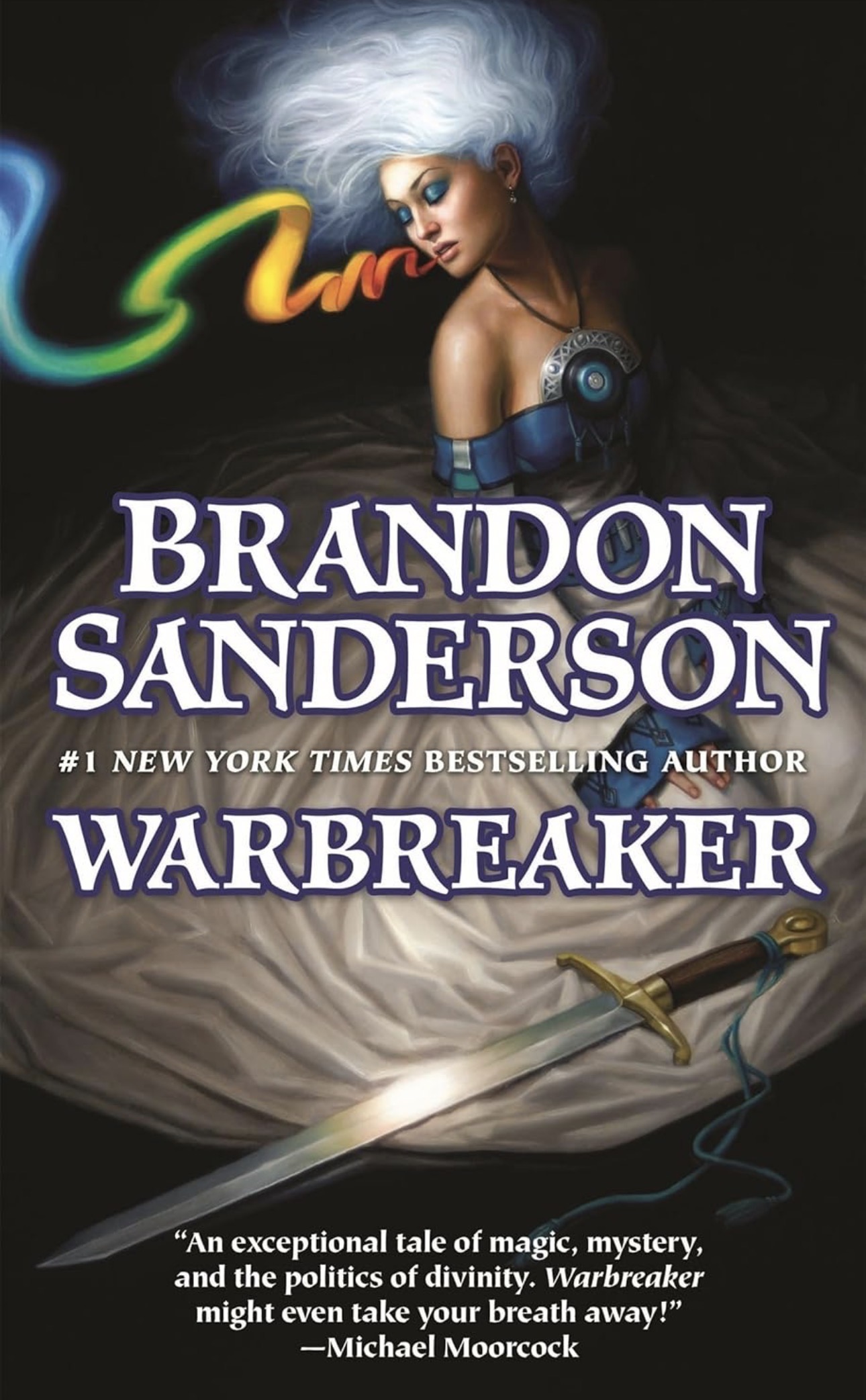
After bursting onto the fantasy scene with his acclaimed debut novel, Elantris, and following up with his blockbuster Mistborn trilogy, Brandon Sanderson proves again that he is today’s leading master of what Tolkien called “secondary creation,” the invention of whole worlds, complete with magics and myths all their own.
Warbreaker is the story of two sisters, who happen to be princesses, the God King one of them has to marry, the lesser god who doesn’t like his job, and the immortal who’s still trying to undo the mistakes he …
After bursting onto the fantasy scene with his acclaimed debut novel, Elantris, and following up with his blockbuster Mistborn trilogy, Brandon Sanderson proves again that he is today’s leading master of what Tolkien called “secondary creation,” the invention of whole worlds, complete with magics and myths all their own.
Warbreaker is the story of two sisters, who happen to be princesses, the God King one of them has to marry, the lesser god who doesn’t like his job, and the immortal who’s still trying to undo the mistakes he made hundreds of years ago.
Their world is one in which those who die in glory return as gods to live confined to a pantheon in Hallandren’s capital city and where a power known as BioChromatic magic is based on an essence known as breath that can only be collected one unit at a time from individual people.
By using breath and drawing upon the color in everyday objects, all manner of miracles and mischief can be accomplished. It will take considerable quantities of each to resolve all the challenges facing Vivenna and Siri, princesses of Idris; Susebron the God King; Lightsong, reluctant god of bravery, and mysterious Vasher, the Warbreaker.
Although the magic system is a bit less formal and more opened to interpretation than the hard magic system of Mistborn (as in, the quality of breaths, commands…), Warbreaker was a fantastic story and one that presented some very interesting characters dynamics and concepts. I particularly liked the concept of the returned and the Court of Gods, each with their own priests, colors, etc. I would love to see this particular world expand into a follow up novel, as the epilogue clearly sets the bases for a sequel.
Sanderson does it again. For some reason, all of Sanderson's series have been really slow starts for me, but then he sucks me in and I can't put the book down. Then at the end, he starts connecting all of the dots, and he had set everything up so well that you have that "Oh!" moment, but didn't see any of the twists coming.