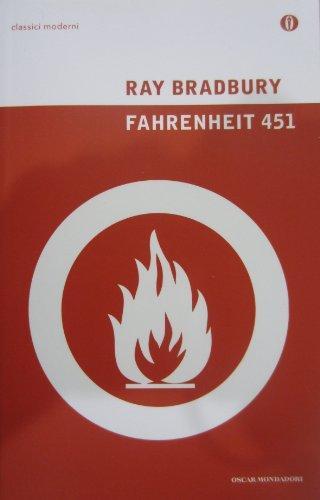
Fahrenheit 451 is a 1953 dystopian novel by American writer Ray Bradbury. Often regarded as one of his best works, the novel presents a future American society where books are outlawed and "firemen" burn any that are found. The book's tagline explains the title as "the temperature at which book paper catches fire, and burns": the autoignition temperature of paper. The lead character, Guy Montag, is a fireman who becomes disillusioned with his role of censoring literature and destroying knowledge, eventually quitting his job and committing himself to the preservation …
Fahrenheit 451 is a 1953 dystopian novel by American writer Ray Bradbury. Often regarded as one of his best works, the novel presents a future American society where books are outlawed and "firemen" burn any that are found. The book's tagline explains the title as "the temperature at which book paper catches fire, and burns": the autoignition temperature of paper. The lead character, Guy Montag, is a fireman who becomes disillusioned with his role of censoring literature and destroying knowledge, eventually quitting his job and committing himself to the preservation of literary and cultural writings.
People have used this novel to focus on the historical role of book burning. Bradbury himself was inspired by the Nazi book burnings and by ideological repression in the Soviet Union. In a 1956 radio interview, Bradbury said that he wrote Fahrenheit 451 because of his concerns at the time, during the Second Red Scare, about the threat of book burning in the United States. In later years, he described the book as a commentary on how mass media reduces interest in reading literature, and, in a 1994 interview, stated that the book was more relevant during this time than in any other because of political correctness which he described as "the real enemy these days", and as "thought control and freedom of speech control".In 1954, Fahrenheit 451 won the American Academy of Arts and Letters Award in Literature and the Commonwealth Club of California Gold Medal. It later won the Prometheus "Hall of Fame" Award in 1984 and a "Retro" Hugo Award in 2004. Bradbury was honored with a Spoken Word Grammy nomination for his 1976 audiobook version.Adaptations of the novel include François Truffaut's 1966 film, Ramin Bahrani's 2018 film, and two BBC Radio dramatizations.
Bradbury published a stage play version in 1979 and helped develop a 1984 interactive fiction computer game of the same name, as well as a collection of his short stories titled A Pleasure to Burn.
Une dystopie qui résonne avec l'époque actuelle...
4 stars
Un livre qui n'est pas sans rappeler 1984 de George Orwell, qui dépeint une société ayant basculé vers le totalitarisme, avec là aussi une police de la pensée et une volonté de supprimer le rêve et la libre pensée des personnes.
Qui n'est pas non plus sans rappeler la politique de certains pays qui se disaient démocratiques il y a encore peu. Assez effrayant dans sa vision quand on pense qu'il a été écrit en 1951.
Un roman assez court, à lire ou à relire absolument. Avant qu'il ne soit lui aussi brûlé.